

Shagle video chat — just one click to talk to people from all over the world!
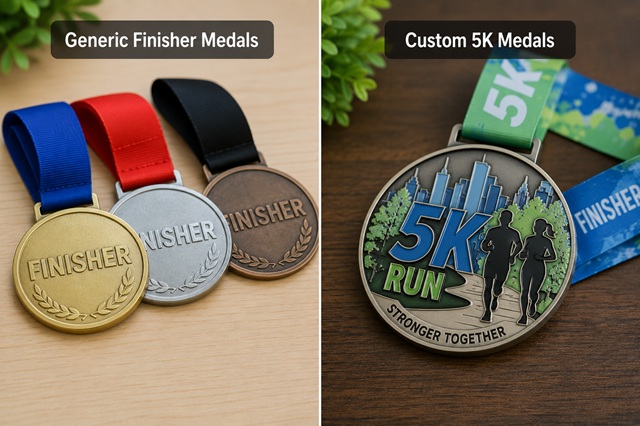
A clear comparison for race organizers, schools, clubs, and community event planners
A 5K event may look simple from the outside, but the medal decision affects cost, participant memory, sponsor visibility, and delivery risk. When organizers start comparing stock finisher awards with 5k medals bulk, the better choice depends on event size, branding needs, timeline, and how much meaning the medal should carry after race day.
Steadyrun readers like clear differences, so let?s compare the two options plainly. A generic medal solves a short-term purchasing problem. A custom medal solves a communication problem: it tells runners what they joined, who supported it, and why the event mattered.
Main Difference Between Generic And Custom 5K Medals
A generic finisher medal is a ready-made award using a standard shape or insert. A custom 5K medal is produced around the event identity, including the race name, date, logo, sponsor message, ribbon, finish, and sometimes a unique shape.
That difference sounds cosmetic. It is not. The choice changes how much control you have over branding, timeline, perceived value, and repeat use for future events.
| Comparison point | Generic finisher medal | Custom 5K medal | Better fit |
| Event identity | Uses a standard design with limited personalization | Built around the race name, logo, date, route, or theme | Custom medals for branded events |
| Sponsor value | Small or no sponsor space | Sponsor logo can appear on medal back, ribbon, or packaging | Custom medals for charity and corporate 5Ks |
| Speed | Usually faster if stock is available | Needs proofing and production time | Generic medals for emergency orders |
| Participant memory | Recognizes completion but may feel ordinary | Connects the runner to a specific race story | Custom medals for annual events |
| Budget control | Good for very small events | Better unit value when ordered in bulk | Custom medals once quantity is planned |
Similarities Race Organizers Should Understand
Both options still need basic planning. You need a quantity, a delivery date, a medal size, and a way to distribute medals at the finish line. You also need a backup plan for late registrations and missing boxes.
Both options can work for a 5K. The mistake is assuming the cheapest option is automatically safer. A stock medal ordered too late can still miss the event. A custom medal ordered with a clean brief can arrive calmly.
- Both options reward participation and finish-line effort.
- Both require a realistic quantity forecast.
- Both should be checked for ribbon length, medal weight, and packaging before race week.
- Both can create a poor experience if delivery is planned too close to the event date.
When Generic Medals Make Sense
Generic medals are useful when the event is small, the budget is tight, or the deadline is already uncomfortable. A school field day, small charity run, or internal wellness event may not need a fully branded die-cast medal.
But generic medals have a ceiling. They do not do much for sponsors, repeat branding, or participant photos. If the event is expected to grow, the medal may start to feel disconnected from the rest of the race identity.
When Custom 5K Medals Are Worth The Planning
Custom medals become more useful when the event has a name, cause, sponsor, school, club, city, or annual theme. That is where a physical award becomes part of the event communication.
For example, a charity 5K can use the medal back for the cause message and the ribbon for sponsors. A school run can use house colors or mascot artwork. A corporate wellness challenge can use clean brand colors and a simple date mark. If a later race needs a different product family, the same supplier can often help with broader custom medals so the visual system stays consistent.
Material And Finish Differences That Affect The Result
Most 5K medals use zinc alloy or iron. Iron can control cost for simple shapes. Zinc alloy gives more freedom for shaped outlines, raised details, and heavier-feeling medals.
From the factory side, zinc alloy melts at about 385?C and flows well into the die cavity. With an 88-ton die-casting machine, detailed 5K shapes, raised logos, and cut-out effects are realistic when the artwork is not too thin. That last part matters. A tiny sponsor logo may look clear on a screen but soften after casting, polishing, plating, and color filling.
| Medal need | Recommended choice | Why it helps |
| Budget school 5K | Iron or simple zinc alloy, soft enamel or printed insert | Controls cost while keeping the event name visible |
| Charity 5K with sponsors | Zinc alloy, double-sided design, printed ribbon | Creates more sponsor surfaces without overcrowding the front |
| Annual community run | Zinc alloy, custom shape, soft enamel | Makes each year feel collectible |
| Corporate wellness race | Zinc alloy, UV print for brand colors | Handles gradients and detailed logos better than enamel alone |
Ordering Timeline And Quantity Planning
A clean order timeline protects the event. Start with the race date and work backward: delivery buffer, packing and QC, production, artwork proof, and quantity confirmation.
Badge Artisans? internal process uses a 24-hour design proof, optional physical samples in 7-10 days, and bulk production commonly around 7-15 days after artwork approval. Those numbers help planners understand why artwork should not be left until the last week. A medals manufacturer should explain the schedule before taking the order, not after a delay appears.
- Confirm expected runners plus late-entry buffer.
- Separate finisher medals from age-group or winner awards.
- Approve artwork before locking unnecessary last-minute changes.
- Ask for production photos or video before shipment when the timeline allows.
Simple Decision Guide
Choose the medal type by asking what the event needs to accomplish. If the medal only needs to exist, stock may work. If the medal needs to carry a story, support sponsors, and appear in photos, custom planning is usually stronger.
| Your event situation | Suggested choice | Reason |
| Fewer than 100 participants and no sponsor needs | Generic medal | Lower setup effort |
| 100+ runners and a named event | Custom 5K medal | MOQ and branding begin to make sense |
| Charity or fundraiser with sponsor exposure | Custom 5K medal | Medal and ribbon can carry the sponsor story |
| Emergency order with no artwork ready | Generic medal first, custom next year | Timeline risk is too high |
| Annual race with repeat participants | Custom medal series | Collectors notice year-to-year identity |
Final Thought
The difference is simple: generic medals finish the transaction; custom medals extend the event. For a small one-time activity, simple may be enough. For a 5K that wants sponsors, photos, repeat runners, and a stronger identity, the custom route gives organizers more control.

