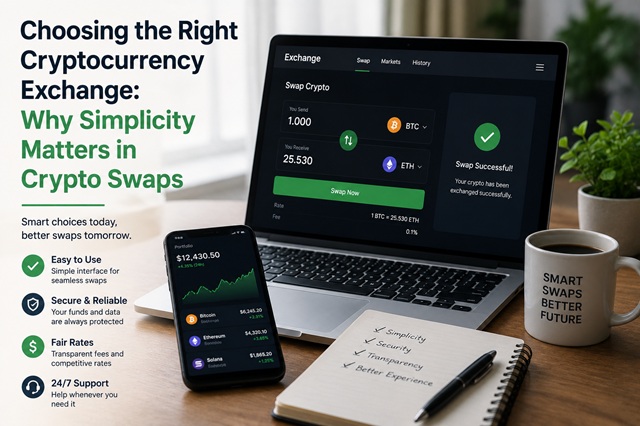
The cryptocurrency ecosystem offers more opportunities than ever before. Thousands of digital assets are available across multiple blockchain networks, decentralized applications continue to grow, and millions of users transfer crypto every day. While this rapid development has expanded the possibilities for investors and blockchain enthusiasts, it has also made one simple task surprisingly complicated—converting one cryptocurrency into another.
A user who wants to swap Bitcoin for Ethereum, exchange a stablecoin for a native blockchain token, or rebalance a portfolio often discovers that many platforms require registration, identity verification, account activation, and several security checks before the first transaction can even begin.
For active traders, these requirements may be perfectly reasonable. But many people aren't looking for a complete trading platform—they simply want to exchange crypto https://godex.io/ quickly and securely.
This is why services operating as a no kyc crypto exchange https://godex.io/ continue to attract attention. Instead of functioning as full-scale trading platforms, they focus on helping users convert supported cryptocurrencies with minimal unnecessary steps.
Understanding how these services work—and how they differ from a traditional cryptocurrency exchange—can help users choose the right tool for every transaction.
Cryptocurrency Is About Choice
One of blockchain technology's greatest strengths is flexibility.
Users can choose:
- which wallet to use;
- which blockchain network to interact with;
- which assets to hold;
- how to secure private keys;
- where to perform exchanges.
Unlike traditional financial systems, cryptocurrency offers multiple ways to accomplish the same goal.
Someone purchasing cryptocurrency for long-term investment may use a regulated centralized exchange.
A trader executing dozens of trades every day may rely on professional trading software.
A decentralized finance user may connect a wallet directly to blockchain applications.
Meanwhile, another person simply wants to swap one digital asset for another without opening another account.
Each of these approaches serves a different purpose.
What Is a Cryptocurrency Exchange?
A cryptocurrency exchange is a platform that enables users to buy, sell, or convert digital assets.
Most centralized exchanges provide a wide variety of services, including:
- spot trading;
- portfolio management;
- fiat currency deposits;
- recurring purchases;
- staking;
- advanced order types;
- market analysis;
- institutional products.
These platforms are designed to support ongoing trading activity.
Users typically create accounts, deposit cryptocurrency or fiat currency, and execute trades using an order book that matches buyers and sellers.
For experienced traders, this environment offers flexibility and precision.
However, many users never utilize the majority of these features.
When Less Is More
Imagine you already own cryptocurrency in your personal wallet.
You don't need technical charts.
You aren't interested in leverage.
You don't plan to leave funds on an exchange.
You simply want to convert one supported asset into another.
In this situation, an instant exchange service may be more practical than navigating an advanced trading platform.
Rather than opening an account and transferring funds into exchange custody, you create a transaction specifically for the swap you want to complete.
The result is delivered directly to your wallet.
For many users, simplicity is a feature rather than a limitation.
Understanding No KYC Exchanges
The phrase no kyc crypto exchange refers to services that generally allow supported cryptocurrency swaps without requiring standard identity verification before initiating a transaction.
"KYC" stands for Know Your Customer.
Financial institutions commonly use KYC procedures to verify customer identity.
This may involve:
- government-issued identification;
- proof of residence;
- biometric verification;
- personal information;
- account creation.
Not every crypto transaction requires the same level of onboarding.
For users who already possess cryptocurrency and simply want to exchange one supported asset for another, account-free swap services can offer a more streamlined experience.
It's important to understand that no-registration does not necessarily mean there are never compliance procedures. Depending on applicable regulations, transaction characteristics, or internal policies, additional review may still occur in certain situations.
Users should always review the platform's terms of service before initiating an exchange.
Why Users Appreciate Wallet-to-Wallet Exchanges
The popularity of wallet-based crypto swaps continues to grow for several reasons.
Control
Users keep cryptocurrency in wallets they manage instead of maintaining exchange balances.
Efficiency
The transaction focuses on a specific conversion instead of long-term account management.
Convenience
No additional login credentials need to be created or maintained.
Reduced Administrative Steps
Users avoid repeatedly completing registration procedures for occasional exchanges.
This workflow can feel more natural for people who already understand cryptocurrency wallets.
Different Goals Require Different Platforms
A person buying cryptocurrency every month through bank transfers has different needs than someone converting digital assets between blockchains.
Similarly, a trader monitoring price charts every hour has different priorities than a developer acquiring native blockchain tokens for application testing.
Choosing the correct platform begins with understanding your objective.
If your objective is trading, an advanced cryptocurrency exchange may be appropriate.
If your objective is simply to exchange crypto, a streamlined swap service may provide everything you need.
Understanding Blockchain Networks
One of the biggest misconceptions among newer crypto users is assuming that every version of a token is identical.
In reality, many cryptocurrencies exist across several blockchain networks.
The token name may remain the same while the underlying blockchain changes completely.
This distinction is extremely important.
Before sending cryptocurrency, verify:
- token name;
- blockchain network;
- recipient wallet compatibility;
- transaction requirements.
Ignoring network compatibility is one of the most common causes of unsuccessful crypto transfers.
Wallet Addresses Deserve Careful Attention
Every cryptocurrency transaction begins with a destination address.
Unlike bank transfers, blockchain payments generally cannot be canceled after confirmation.
This makes address verification essential.
Good habits include:
copying addresses directly from the wallet;
avoiding manual typing;
checking the first characters;
checking the final characters;
confirming the blockchain network.
Some malicious software replaces copied wallet addresses.
Taking a few seconds to verify the address can prevent significant losses.
Network Fees Are Part of Every Transaction
Blockchain transactions require network validation.
Validators or miners receive compensation through transaction fees.
Most networks require payment using their native cryptocurrency.
Examples include:
Bitcoin network — BTC
Ethereum — ETH
BNB Smart Chain — BNB
Solana — SOL
TON — TON
This creates an important consideration.
A wallet may contain tokens but still lack the native cryptocurrency needed to move them.
Before creating an exchange order, always verify that your wallet contains enough native currency to pay network fees.
How Crypto Swap Services Work
Most instant exchange platforms follow a similar workflow.
The user chooses the cryptocurrency to send.
Next, the user selects the cryptocurrency to receive.
The destination wallet address is entered.
The service generates an exchange order.
A deposit address is provided.
The user transfers cryptocurrency.
After blockchain confirmation, the exchange is completed.
The resulting asset is sent to the specified wallet.
The process is designed around a single transaction rather than ongoing account activity.
Exchange Rates Explained
The cryptocurrency market operates continuously.
Prices change every second.
As a result, exchange services generally use either floating or fixed pricing.
Floating rates follow market movement during order processing.
Fixed rates attempt to preserve the quoted conversion rate for a limited period.
Each option has advantages depending on market conditions.
Users should review the exchange terms before confirming a transaction.
Common Situations Where People Exchange Crypto
There are many practical reasons to convert one cryptocurrency into another.
Someone may receive payment in Bitcoin but need Ethereum.
Another user may purchase a blockchain game's native token.
An investor may rebalance a portfolio.
A freelancer may convert crypto income into a stablecoin.
A developer may need assets compatible with another blockchain.
A DeFi participant may prepare funds for a decentralized protocol.
These examples illustrate that cryptocurrency exchanges are useful for far more than speculative trading.
Security Starts Before the Transaction
Technology alone cannot prevent every mistake.
Users remain responsible for verifying transaction details.
Before sending cryptocurrency:
confirm the website domain;
verify the wallet address;
double-check the blockchain network;
review the exchange amount;
confirm the destination currency;
save the transaction details.
Most mistakes occur before the transaction reaches the blockchain.
Careful preparation significantly reduces risk.
Understanding Transaction Confirmations
Every blockchain processes transactions differently.
Some networks confirm transfers quickly.
Others require additional confirmations before an exchange service considers the deposit complete.
During busy periods, processing times may increase.
This does not necessarily indicate a problem.
Users should keep the transaction hash, which provides proof that the transfer has been broadcast to the blockchain.
The transaction hash also helps customer support investigate issues if necessary.
Mistakes That Can Delay an Exchange
Several common errors appear repeatedly.
Sending cryptocurrency through the wrong network.
Using an expired exchange order.
Sending less than the required minimum.
Ignoring destination tags or memos.
Sending multiple deposits when one was expected.
Entering the wrong wallet address.
Attempting to exchange unsupported assets.
Most of these issues can be prevented by reviewing transaction details before sending funds.
Privacy and Responsibility
Privacy is one reason many users choose a no kyc crypto exchange.
However, privacy also increases personal responsibility.
Without centralized account recovery, users must protect:
wallet passwords;
private keys;
recovery phrases;
backup copies.
No legitimate exchange service can restore access to a wallet if the recovery phrase is permanently lost.
The safest approach is to store recovery information offline in a secure location.
How to Evaluate an Exchange Service
Before choosing any platform, ask several practical questions.
Does it support the cryptocurrency you need?
Does it support the correct blockchain?
Are exchange limits clearly displayed?
Can you monitor transaction progress?
Is customer support available?
Are exchange terms transparent?
Does the website clearly explain the process?
Good platforms make important information easy to find.
Why Wallet Ownership Remains Important
Many experienced cryptocurrency users prefer self-custody.
Keeping assets in a personal wallet reduces dependence on centralized platforms for long-term storage.
When using an exchange service, funds are typically transferred only for the duration of the specific conversion.
Once the exchange is complete, the new cryptocurrency arrives in the user's own wallet.
This approach supports one of cryptocurrency's core principles—personal control over digital assets.
At the same time, users must understand that self-custody requires careful security practices.
How Godex Helps Users Exchange Crypto
Godex is designed for users who want to exchange crypto without creating a permanent trading account.
The process focuses on individual exchange orders rather than ongoing account management.
Users choose the asset they wish to send, select the cryptocurrency they want to receive, provide a destination wallet address, review the transaction details, and complete the transfer.
After the blockchain confirms the deposit, the exchanged cryptocurrency is sent to the specified wallet.
As with every blockchain transaction, users should carefully verify wallet addresses, supported networks, transaction amounts, and any required destination tags before sending funds.
Is a No KYC Crypto Exchange the Right Choice?
Every cryptocurrency user has different priorities.
Some value advanced trading functionality.
Others prioritize privacy.
Some need fiat banking integration.
Others simply want to convert one cryptocurrency into another.
A no kyc crypto exchange can be particularly useful for users who:
already own cryptocurrency;
manage personal wallets;
need occasional asset conversions;
prefer fewer registration requirements;
do not require advanced trading tools;
want wallet-to-wallet transactions.
Choosing the appropriate exchange method depends on your specific objective rather than following a single approach for every situation.
Final Thoughts
The cryptocurrency industry continues to offer more flexibility with each passing year. Users can select the wallets they trust, the networks they prefer, and the services that best fit their individual needs.
A traditional cryptocurrency exchange remains an excellent solution for active trading, portfolio management, and advanced market participation. At the same time, users looking for a straightforward way to exchange crypto may find that an account-free swap service better matches their workflow.
A no kyc crypto exchange is not about eliminating responsibility—it is about reducing unnecessary complexity. Users still need to verify addresses, confirm blockchain networks, understand transaction fees, and protect their wallets. These habits remain essential regardless of which platform is used.
In cryptocurrency, successful transactions are built on preparation. Choosing the correct service, reviewing every transaction detail, and maintaining control of your own wallet are simple practices that contribute to a safer and more efficient crypto experience.